
Many organizations still rely on spreadsheets, shared folders, and email threads to manage compliance.
At first glance, this approach seems manageable. Policies are documented, evidence is collected, and reviews are scheduled manually.
But as companies grow, manual compliance management begins to create hidden costs that affect efficiency, risk management, and governance visibility.
What initially works for a small team can quickly become difficult to maintain at scale.
Understanding these hidden costs is often the first step toward building a stronger governance foundation.
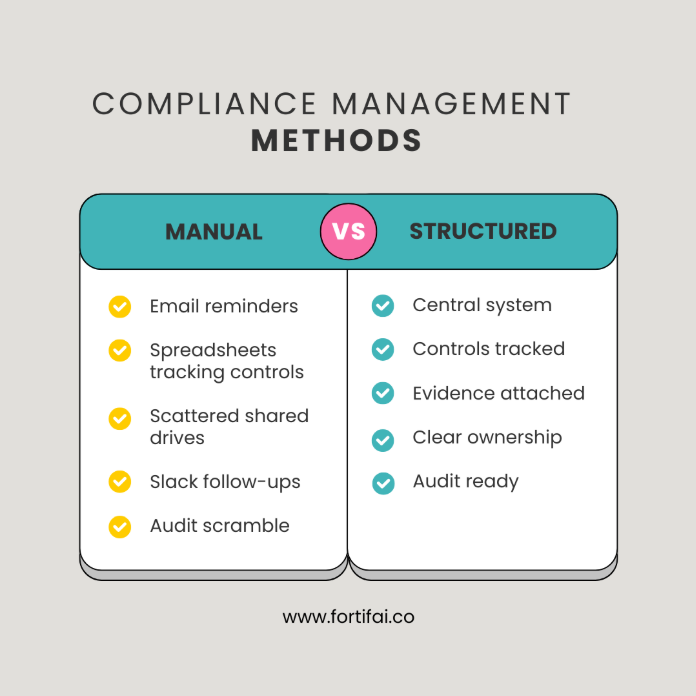
Manual compliance systems are common because they are easy to start.
Most companies begin with tools they already use:
For early-stage organizations, this approach can work reasonably well.
However, as regulatory expectations increase and operations expand, these systems often struggle to keep up.
One of the biggest hidden costs of manual compliance management is time.
Compliance leaders and operations teams often spend hours each week:
These tasks are necessary, but they do not directly strengthen governance or reduce risk.
Over time, compliance work becomes dominated by administrative maintenance rather than strategic oversight.
Manual systems rely heavily on consistent human input.
Even well-organized teams can experience issues such as:
These errors rarely happen intentionally. They are simply a natural outcome of systems that depend on manual tracking across multiple tools.
During audits or due diligence processes, these gaps can become highly visible.
Many organizations believe they are compliant because policies and controls exist somewhere within the organization.
But demonstrating compliance requires more than having documentation.
Auditors, regulators, and investors often expect organizations to show:
When information is spread across spreadsheets, folders, and emails, assembling this proof can become a time-consuming exercise.
Teams may spend days collecting documents that should already be centralized and organized.
Audits and investor due diligence often reveal the limitations of manual compliance systems.
When requests arrive, teams must gather information from multiple places, including:
Without centralized oversight, preparing responses can become a reactive scramble.
This not only slows the process but may also create uncertainty for external stakeholders evaluating the company’s governance maturity.
Manual compliance management also limits leadership visibility.
Without structured systems, leaders may struggle to answer questions such as:
When information lives across disconnected spreadsheets and documents, gaining a clear picture of governance health becomes difficult.
Manual compliance processes may appear inexpensive, but the long-term cost can include:
As organizations scale, these issues become harder to manage.
Companies that move toward more structured compliance management systems often gain something critical: clarity and confidence in their governance processes.
Many companies assume their governance processes are working — until an audit, certification process, or investor due diligence request tests them.
If your organization still relies on spreadsheets, manual reminders, and scattered documentation, it may be worth taking a closer look.
Understanding the strengths and gaps in your governance framework can help identify where improvements are needed.
Take the quick assessment to see how defensible your governance setup really is.
👉 Take the Governance Readiness Quiz and Get our Free Guide on ‘Practical Governance Baseline’


