

Most CFOs track financial debt with precision.
They understand leverage ratios, cost of capital, repayment timelines, and risk exposure.
But there is another form of debt accumulating inside many organizations that rarely appears on a balance sheet:
governance debt.
Governance debt builds quietly when controls, documentation, and oversight structures fail to scale with the organization.
At first, it feels manageable.
Teams coordinate informally. Documentation exists somewhere. Leaders assume processes are working.
But when pressure arrives — an audit, regulatory review, investor due diligence, or board inquiry — the hidden liabilities of weak governance structures become visible.
And unlike financial debt, governance debt is often discovered only when it is already costly.
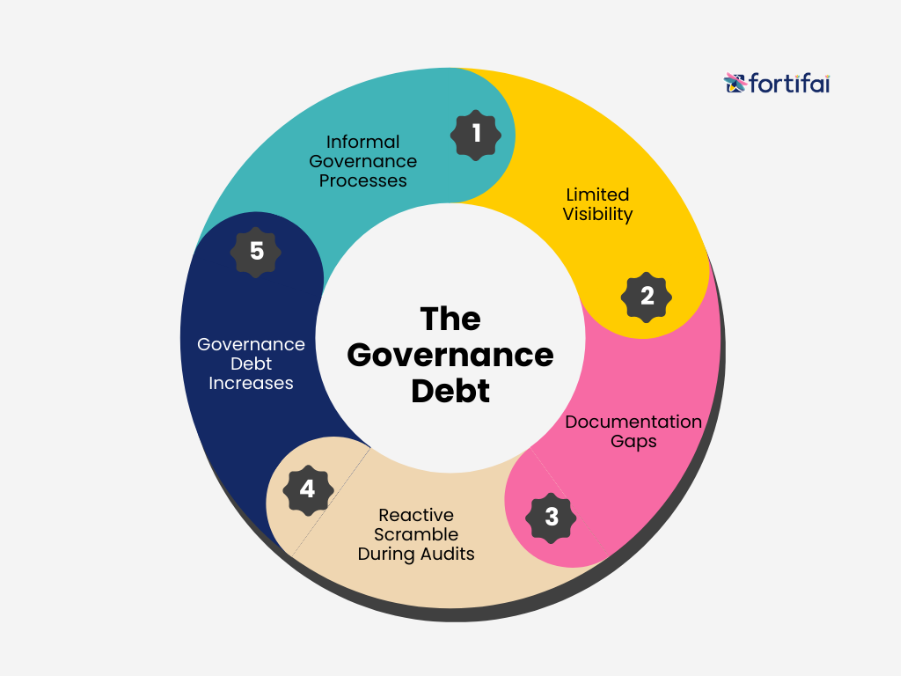
Governance debt emerges when operational growth outpaces governance structure.
This typically happens across three layers:
Controls may technically exist, but leaders cannot easily answer questions like:
Without clear visibility, organizations rely on assumptions rather than oversight.
Documentation often accumulates in disconnected locations:
This fragmentation creates a hidden cost: proving compliance becomes a reconstruction exercise.
As organizations grow, governance responsibilities spread across departments:
Without structured coordination, governance becomes dependent on personal communication rather than institutional systems.
When key individuals leave or priorities shift, governance continuity weakens.
CFOs can quickly identify governance debt by asking a few structural questions.
Consider the following diagnostic.
Can leadership easily identify:
If answering these questions requires multiple spreadsheets or team inquiries, governance visibility may already be compromised.
If an auditor requested documentation tomorrow, could the organization provide evidence of control performance within 48 hours?
Or would teams need to gather evidence from multiple departments?
Delays in producing documentation often signal governance debt.
Are governance responsibilities clearly structured across domains such as:
Or does coordination depend largely on informal communication between teams?
When governance relies on coordination rather than structure, fragility increases.
Governance debt rarely creates immediate operational problems.
Instead, it becomes visible during moments of scrutiny, such as:
Auditors often focus not only on controls themselves but also on the systems used to manage them.
Fragmented documentation or unclear control ownership can quickly raise questions about oversight maturity.
During fundraising or acquisitions, investors often evaluate governance resilience.
When documentation must be assembled reactively, delays can signal structural weakness.
Regulators increasingly expect organizations to demonstrate structured governance processes.
Manual tracking methods may struggle to meet these expectations consistently.
Governance debt rarely results from negligence.
More often, it reflects the natural evolution of growing organizations.
Early-stage companies prioritize speed and flexibility.
Controls are introduced gradually.
Documentation grows organically.
Over time, however, the organization’s operational complexity outpaces its governance infrastructure.
Without deliberate investment in governance systems, the gap continues to widen.
Addressing governance debt does not necessarily require large compliance teams or complex programs.
Instead, the focus should be on structural clarity.
Effective governance systems typically include:
When these elements are in place, organizations can respond to scrutiny quickly and confidently.
Many leadership teams assume their governance processes are functioning well.
But the real test often comes when external stakeholders request evidence.
A useful question for leadership teams is simple:
Could our governance framework withstand external scrutiny tomorrow?
If the answer is uncertain, it may be worth evaluating the current governance structure more closely.
If you're evaluating the strength of your organization’s governance framework, a structured diagnostic can help identify potential blind spots.
The Governance Readiness Assessment examines key areas including:
It provides a quick way to evaluate whether governance processes are structured to support audits, due diligence, and board oversight.


